
 By Olivia Wilson Media Team
Choosing between AWS and Azure can feel overwhelming when you’re trying to find the best cloud solution for your business. The droven io AWS vs Azure comparison helps you understand which platform aligns better with your specific needs, budget, and technical requirements. Both cloud giants offer robust features, but they differ significantly in pricing models, service offerings, and integration capabilities. This comprehensive guide walks you through everything you need to know to make an informed decision that supports your business growth and technical infrastructure.
Cloud computing has transformed how businesses operate, and selecting the right platform impacts your operational efficiency, costs, and scalability. Whether you’re a startup looking for cost-effective solutions or an enterprise needing advanced features, understanding the differences between AWS and Azure through the droven io perspective gives you practical insights. The comparison isn’t about which platform is universally better, but rather which one suits your particular situation, technical stack, and future plans.
When examining the droven io AWS vs Azure comparison, the core features reveal distinct approaches to cloud computing. AWS offers over 200 fully featured services from data centers globally, making it the most comprehensive cloud platform available. Azure, meanwhile, focuses heavily on hybrid cloud capabilities and seamless integration with Microsoft products, which appeals to businesses already invested in the Microsoft ecosystem.
AWS excels in providing granular control over infrastructure with services like EC2 for computing, S3 for storage, and RDS for databases. The platform’s maturity means you’ll find extensive documentation, community support, and third-party tools. Azure counters with strong enterprise features, including Active Directory integration, robust compliance certifications, and superior support for Windows-based applications. The choice between these platforms often comes down to whether you prioritize breadth of services or depth of enterprise integration.
Both platforms support containerization through Kubernetes, serverless computing, and machine learning capabilities. However, AWS Lambda pioneered serverless computing and maintains a slight edge in maturity, while Azure Functions integrates smoothly with Visual Studio and other development tools familiar to .NET developers. The droven io framework helps businesses evaluate these features based on actual usage patterns rather than just marketing promises.
Pricing represents one of the most critical factors in any cloud decision, and the droven io AWS vs Azure comparison reveals nuanced differences. AWS uses a pay-as-you-go model with pricing based on usage across compute, storage, and data transfer. Azure follows a similar approach but often offers better pricing for enterprises committed to long-term contracts, especially those already using Microsoft software licenses through programs like Azure Hybrid Benefit.
AWS pricing can become complex with numerous service tiers, instance types, and regional variations. The platform offers Reserved Instances and Savings Plans that provide discounts up to 72% for committed usage, which benefits businesses with predictable workloads. Azure’s pricing tends to be more straightforward for Windows-based workloads and offers per-minute billing compared to AWS’s per-hour billing for certain services, potentially reducing costs for sporadic usage patterns.
Hidden costs exist on both platforms, particularly around data egress fees and premium support tiers. The droven io AWS vs Azure comparison emphasizes calculating total cost of ownership rather than just comparing sticker prices. Businesses often find AWS slightly cheaper for Linux-based workloads and storage-intensive applications, while Azure provides better value for Windows environments and hybrid scenarios. Using cost calculators from both providers and modeling your specific workload gives you the most accurate comparison.
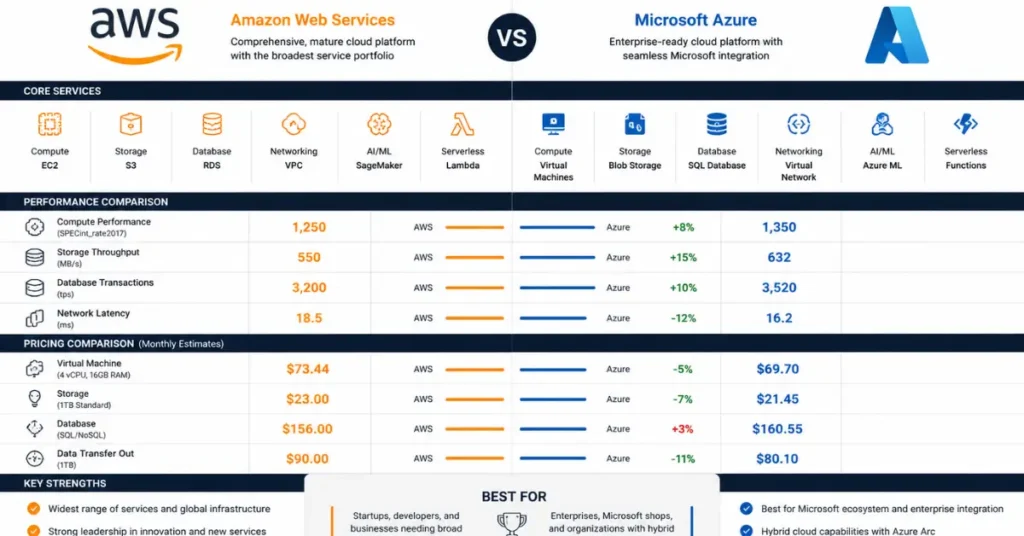
Performance considerations in the droven io AWS vs Azure comparison extend beyond raw computing power to include network latency, global availability, and service uptime. AWS operates the largest global infrastructure with 31 geographic regions and 99 availability zones, providing exceptional redundancy and low-latency access worldwide. Azure follows closely with 60+ regions, making it the most geographically distributed cloud platform, which benefits businesses requiring data residency in specific countries.
Both platforms guarantee 99.99% uptime for their core services through comprehensive SLAs, though actual performance depends on how you architect your applications. AWS pioneered the availability zone concept, where multiple isolated data centers within a region provide fault tolerance. Azure uses similar architecture with availability sets and zones, ensuring your applications remain operational even during infrastructure failures.
Network performance varies based on your location and the specific services used. AWS generally shows slightly better performance for content delivery through CloudFront, while Azure’s ExpressRoute provides reliable private connections for enterprise environments. The droven io AWS vs Azure comparison suggests testing both platforms with your actual workloads, as performance differences often matter less than proper architecture and optimization. Most businesses find both platforms deliver excellent performance when configured correctly, making other factors like integration and tooling more decisive.
The ecosystem surrounding each platform significantly impacts your development velocity and operational efficiency. In the droven io AWS vs Azure comparison, AWS demonstrates the broadest third-party integration ecosystem with thousands of partner solutions, extensive marketplace offerings, and mature tooling. Developers appreciate AWS’s API-first approach and comprehensive SDKs for virtually every programming language.
Azure shines when your organization already uses Microsoft products like Office 365, Dynamics 365, or on-premises Windows Server infrastructure. The seamless integration between Azure Active Directory and cloud services simplifies identity management and security policies. Visual Studio integration, Azure DevOps, and native support for .NET frameworks make Azure the natural choice for development teams invested in Microsoft technologies.
Both platforms support multi-cloud and hybrid deployments, though with different philosophies. AWS focuses on cloud-native approaches and provides tools like AWS Outposts for extending cloud services on-premises. Azure built hybrid cloud into its core strategy with Azure Arc and Azure Stack, allowing consistent management across cloud and on-premises environments. The droven io perspective recommends evaluating integration based on your existing technology stack and whether you plan to migrate entirely to the cloud or maintain hybrid infrastructure.
Security remains paramount in any cloud decision, and the droven io AWS vs Azure comparison shows both platforms invest heavily in protecting customer data. AWS provides over 300 security, compliance, and governance services and features, including sophisticated identity management through IAM, encryption at rest and in transit, and extensive logging through CloudTrail. The platform holds more compliance certifications than any competitor, covering industries from healthcare to government.
Azure emphasizes security through Microsoft’s enterprise heritage, offering Azure Security Center for unified security management and threat protection. The platform provides excellent compliance support, particularly for industries requiring specific certifications like HIPAA, FedRAMP, and GDPR. Azure’s integration with Microsoft Defender and Azure Sentinel provides comprehensive security monitoring that appeals to security teams familiar with Microsoft security products.
Both platforms follow the shared responsibility model where they secure the infrastructure while you secure your applications and data. AWS tends to offer more granular security controls, giving experienced teams flexibility to implement custom security architectures. Azure provides more guided security features that help less specialized teams implement strong security quickly. The droven io AWS vs Azure comparison emphasizes that both platforms can be equally secure when properly configured, making your team’s expertise and preferred security tools more important than platform-specific features.
The developer experience differs substantially between platforms, affecting productivity and time to market. The droven io AWS vs Azure comparison finds that AWS offers unmatched documentation and community resources due to its market leadership and longer history. Developers appreciate AWS’s consistency in API design and the extensive tutorials, sample code, and community forums available for troubleshooting.
Azure provides an excellent experience for developers already familiar with Microsoft development tools and practices. Visual Studio Code integration, Azure DevOps pipelines, and comprehensive .NET support create a smooth workflow for Windows-centric development teams. The Azure portal receives frequent updates and generally offers a more intuitive interface compared to AWS’s console, though this remains subjective and depends on personal preferences.
Learning curves vary based on your background and the services you need. AWS requires understanding its unique terminology and service naming conventions, which can initially confuse newcomers. Azure’s naming tends to be more straightforward, especially for common services, though the platform reorganizes features more frequently, sometimes creating confusion. The droven io framework suggests that teams new to cloud computing often find Azure slightly easier to start with, while teams prioritizing flexibility and advanced features prefer AWS’s approach once they overcome the initial learning curve.
Support quality can make or break your cloud experience, especially during critical outages or complex implementations. In the droven io AWS vs Azure comparison, both platforms offer tiered support plans ranging from basic free support to enterprise-level assistance with dedicated technical account managers. AWS support pricing starts at $29 monthly for developer support and scales to 10% of monthly usage for enterprise support, which includes response times under 15 minutes for critical issues.
Azure’s support structure mirrors AWS with developer, standard, and professional direct plans, plus premier support for large enterprises. Azure tends to provide better support responsiveness for organizations with existing Microsoft Premier Support agreements, allowing consolidated support across cloud and on-premises Microsoft products. This integration simplifies support management for IT teams already working with Microsoft.
Community resources significantly extend official support, and AWS maintains a substantial lead in community size and third-party content. You’ll find more Stack Overflow questions answered, blog posts, video tutorials, and conference presentations about AWS services. Azure’s community grows rapidly, particularly among .NET developers and enterprises migrating Microsoft workloads. The droven io AWS vs Azure comparison notes that for uncommon scenarios or advanced configurations, AWS’s larger community often provides faster solutions through unofficial channels.
Choosing between AWS and Azure requires evaluating your specific circumstances rather than following general recommendations. The droven io AWS vs Azure comparison framework suggests starting with your existing technology investments and team expertise. Organizations heavily invested in Microsoft technologies, Windows Server environments, or .NET development typically find Azure provides better integration and faster time to value.
Companies prioritizing maximum flexibility, cutting-edge features, or Linux-based workloads often prefer AWS. Startups and businesses building cloud-native applications from scratch benefit from AWS’s breadth of services and extensive startup support programs. Multi-cloud strategies where you use both platforms for different purposes are increasingly common, though they add management complexity.
Consider running small pilot projects on both platforms before committing to large migrations. Most businesses find that pricing differences become negligible at scale when comparing similar architectures, making factors like developer productivity, integration capabilities, and operational tooling more important than raw costs. The droven io perspective emphasizes that both AWS and Azure are excellent platforms capable of supporting virtually any workload, and your decision should focus on which platform aligns better with your team’s skills, existing infrastructure, and strategic direction rather than attempting to identify an objectively superior option.
Azure is often cheaper for Microsoft users, while AWS may cost less for Linux-based and startup workloads.
Yes, many businesses use both platforms to avoid vendor lock-in and gain flexibility.
Azure is usually easier for Microsoft users, while AWS offers more learning resources and community support.
AWS offers mature ML tools like SageMaker, while Azure provides strong integration and beginner-friendly AutoML features.
Consider your current tools, team expertise, workload needs, and long-term cloud strategy.
The droven io AWS vs Azure comparison reveals that both platforms offer robust, enterprise-grade cloud services capable of supporting businesses of any size. Your choice ultimately depends on your specific technical requirements, existing infrastructure, team expertise, and strategic goals rather than identifying a universally superior platform. AWS provides unmatched breadth of services, extensive community support, and cutting-edge features that appeal to cloud-native development and startups prioritizing flexibility. Azure excels in hybrid cloud scenarios, Microsoft ecosystem integration, and enterprise features that simplify migrations for organizations already invested in Microsoft technologies.
Successful cloud adoption focuses less on choosing the “best” platform and more on selecting the right platform for your situation. Both AWS and Azure continue investing billions in infrastructure, features, and global expansion, ensuring either choice provides a solid foundation for your cloud journey. The droven io framework helps you move beyond surface-level comparisons to evaluate how each platform’s strengths align with your business needs, enabling confident decisions that support long-term success in the cloud.